AI Implementation for Law Firms & Professional Services
I'm a daily AI user since GPT-3 and a California attorney since 2011. I run ethics-compliant AI rollouts for solo practitioners, small firms, and in-house legal teams, so the upside reaches the work product before a bar complaint reaches your inbox.
Sergei Tokmakov, Esq. · California Bar #279869 · BU Law J.D.

Who I help
If you produce written work product for clients and your data is sensitive, you're in the right place. AI without supervision is malpractice insurance bait. AI without strategy is shelfware.
Solo attorneys
You're already pasting things into ChatGPT. I help you do it safely, document it, and bill for the right amount of time.
Small firms (2-50 lawyers)
You need one written policy that covers every associate, a vendor matrix, and a training rhythm that doesn't pull partners off billable work.
In-house GCs & legal ops
Procurement wants an AI Use Policy. Outside counsel wants a vendor diligence template. I build both, plus a board-level summary.
Accountants & CPAs
Engagement letters, tax memos, client intake. The confidentiality calculus is similar to law: AI ROI is real, supervision still mandatory.
Professional services
Architects, consultants, financial advisors, healthcare admins - anyone whose client files are confidential and whose deliverables are written.
Founder-led legal departments
One in-house attorney, twenty open projects, no time. AI workflows that one person can actually supervise are my specialty.
What goes wrong without expert reviewI've watched all of these happen in real firms. Most were avoidable with a thirty-page policy and an hour of training.
-
Confidentiality leaks CRPC 1.6
An associate pastes the deposition transcript into a personal free-tier chatbot account to summarize it. Depending on the account type and its data-control settings, that transcript may now be eligible for use in model improvement. Rule 1.6 prohibits revealing client information without informed consent, and "I didn't realize the box was checked" is not a defense. The fix is contractual: enterprise plans that disable training, paired with a policy that names which tools handle which data class.
-
Competence gaps CRPC 1.1 · ABA Op. 512
Rule 1.1 now requires understanding the benefits and risks of relevant technology. ABA Formal Opinion 512 (July 2024) operationalized this for generative AI. A partner who doesn't know what their tools do can't supervise; a partner who refuses to learn is increasingly out of step with the standard of care.
-
Unsupervised AI CRPC 5.3
Rule 5.3 makes you responsible for non-lawyer assistants. The State Bar guidance treats AI tools as non-lawyer assistants. That means every output that leaves your firm needs a human review trail, and every staffer needs to know which tools are approved for which task. Without a written policy, the supervisory record doesn't exist.
-
Billing disclosure CRPC 1.5
Rule 1.5 prohibits unreasonable fees. If AI compresses a four-hour task to forty minutes, the client gets the savings - not a four-hour invoice. Some matters are flat-fee, some are hourly, and AI changes the math for both. I help firms write engagement letters that say plainly what's billed for AI-assisted work.
-
Client disclosure CRPC 1.4
There's no universal duty to tell clients you use AI, but Rule 1.4 (communication) plus the State Bar guidance both lean toward disclosure when AI materially affects deliverables or fees. A one-page engagement-letter addendum solves this. Failing to disclose, when the client would reasonably want to know, is the kind of thing that surfaces in a bar complaint years later.
My AI stack - radical transparencyIf I'm going to advise on your AI use, you should know exactly what I use in my own practice and how I keep client data out of the wrong places.
What I use
- Claude (Opus, Sonnet): Primary drafting and analysis. Anthropic Claude.ai Team plan; training disabled by contract.
- Claude Code: Codebase work for Terms.Law and client tools. Runs against the Anthropic API; same data posture as Claude.
- ChatGPT (Team): Second-opinion drafting, ideation, fast research. Team-tier; training off.
- Cursor: IDE-integrated AI for engineering work on this site and document generators.
- Custom workflows: Document generators, intake bots, redline tools - purpose-built per client.
- Gemini (read-only): I read Gemini outputs to understand competitive landscape; I do not paste client work into Gemini.
How I keep it ethical
- No identifying client data in prompts: I redact names, addresses, account numbers, and case numbers before pasting. Facts and patterns only.
- Contractual non-training only: Every tool I use for client work has a written commitment that prompts are not used for training. Free tiers are excluded from client work.
- Human review is mandatory: No AI output leaves my desk without me reading every word. I check every citation against the primary source before it becomes legal work product.
- Disclosed in engagement letters: Every engagement letter explains, in plain English, that AI assists with drafting and that I supervise outputs.
- Local-first where possible: For the most sensitive work, I use redaction tools and keep the analysis on my machine.
- I document my own useFull breakdown here - same transparency I'd ask of any firm I audit.
What you get
Most firms start with the $2,500 audit, then choose an implementation program: the $10,000 Practice Sprint, the $20,000 Firm AI Operating System, or the $30,000 Firmwide Transformation Program. The $300/hr option is for one-off questions and vendor reviews.
Hourly Advisory
- AI vendor contract review
- Specific AI ethics question (written opinion)
- Single-document review (engagement letter, policy addendum)
- Written response within two business days
- No retainer
AI Use Audit & Policy Package
- Firm-wide AI use audit (current tools, data flows, risks)
- Written AI Use Policy customized to your practice areas
- Vendor diligence checklist with named-vendor scoring
- Client AI disclosure addendum for engagement letters
- One-hour live training session (recorded)
- Two rounds of revisions over 30 days
AI Practice Implementation Sprint
- Includes the $2,500 audit
- Workflow design for two core practice workflows
- Verification & QC protocol per the California Bar 2026 guidance
- Firm AI use policy + two live training sessions
- 30 days of implementation support
Firm AI Operating System Build
- Everything in the Sprint
- Full intake-to-delivery AI architecture
- Document-generation pipelines
- Governance & client-disclosure framework
- Structured attorney/staff training program + 60-day rollout support
AI Transformation Program
- Everything in the Operating System build
- Per-practice-group rollout
- Custom client-workroom / portal architecture
- Adoption metrics + 90 days of standing advisory
- Larger firms and multi-office rollouts quoted above the base fee
Ready to put real guardrails around your AI use?
The $2,500 Audit & Policy Package is the fastest way to go from "we use AI sometimes" to a documented, defensible firm-wide practice.
Why me, specificallyThere are AI consultants who don't know legal ethics, and there are legal ethics teachers who don't use AI. I'm both.
What you are actually buying: direct attorney work, not a junior associate, not an offshore team, not a generic AI consultant. I've been a daily user of generative AI since the GPT-3 API was a private beta. I've handled 1,800+ matters, run a static-HTML law firm at terms.law, and spent the last three years writing AI Use Policies for clients in California, New York, Texas, and Illinois. I read every California Bar opinion, every ABA opinion, and every relevant vendor TOS before I write a single line of your policy.
Recent engagements
Illustrative composite snapshots based on patterns from my implementation work, plus one real, documented incident from my own infrastructure. Full case studies live on the case-studies page.
Pasted depositions into free ChatGPT
Drafted a 12-page AI Use Policy with vendor matrix, client-disclosure addendum, and a one-hour training. $2,500 flat.
In-house legal · SaaSBuilt an internal NDA red-flagger
Custom Claude workflow plus a written policy that procurement would actually accept. $4,500 implementation.
Accounting firm · TXAI-assisted engagement-letter generator
Replaced a 20-minute manual process with a 2-minute generator, plus a confidentiality policy clients sign.
The intake system, screen by screen
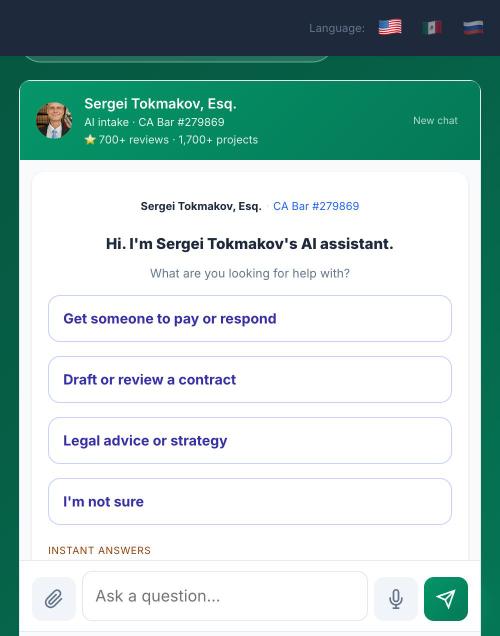
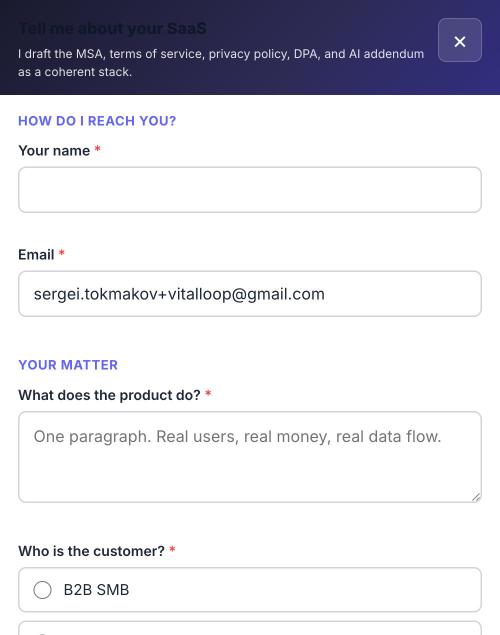
This is not a mockup. These are the live screens on my own Healthcare SaaS legal package page, which is the highest-value product line I run. Across 278 sessions the system averages 4.3 exchanges and 1.9 minutes before it either routes someone to a fixed-fee package or tells them they do not need to hire anyone.
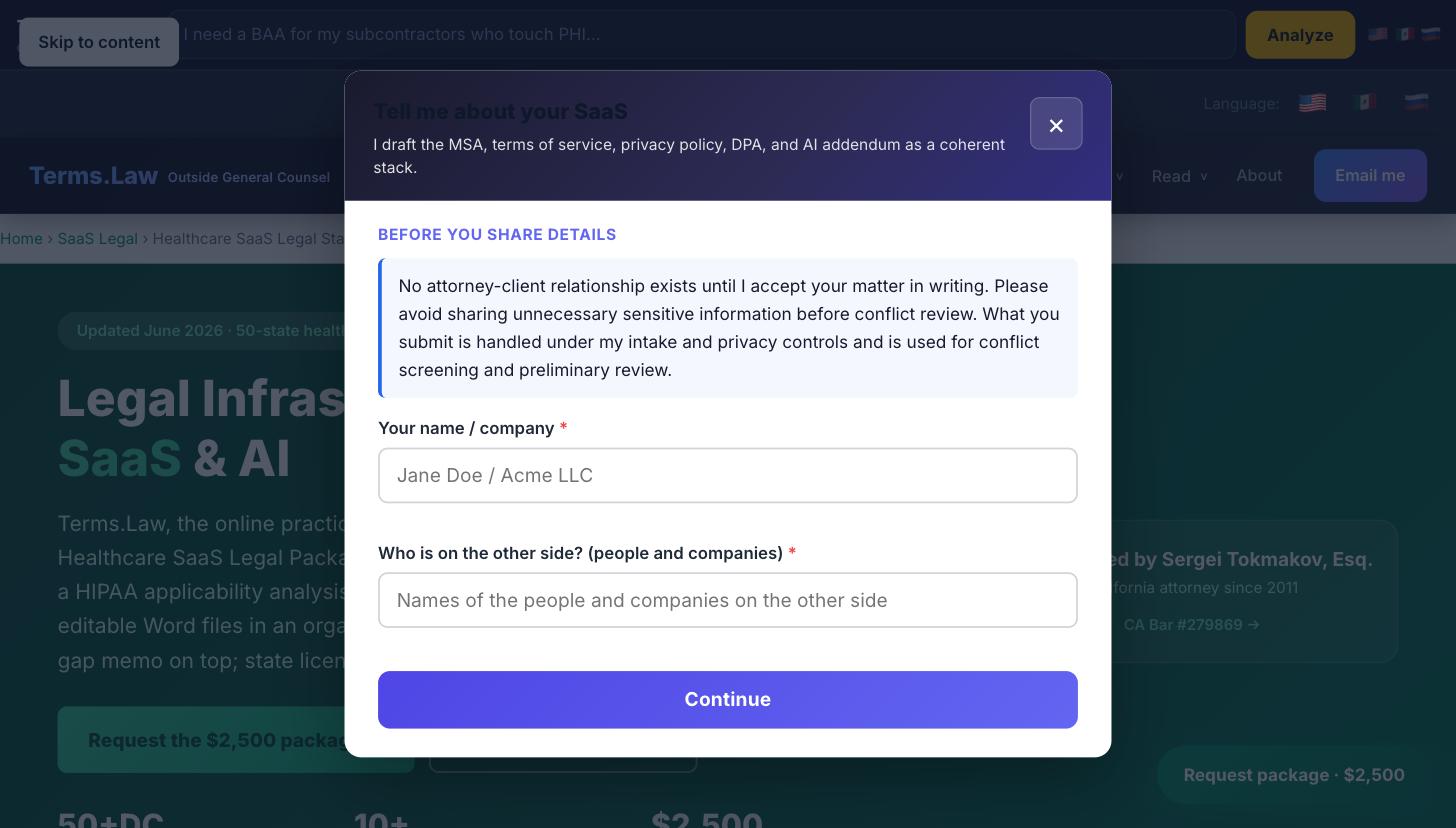
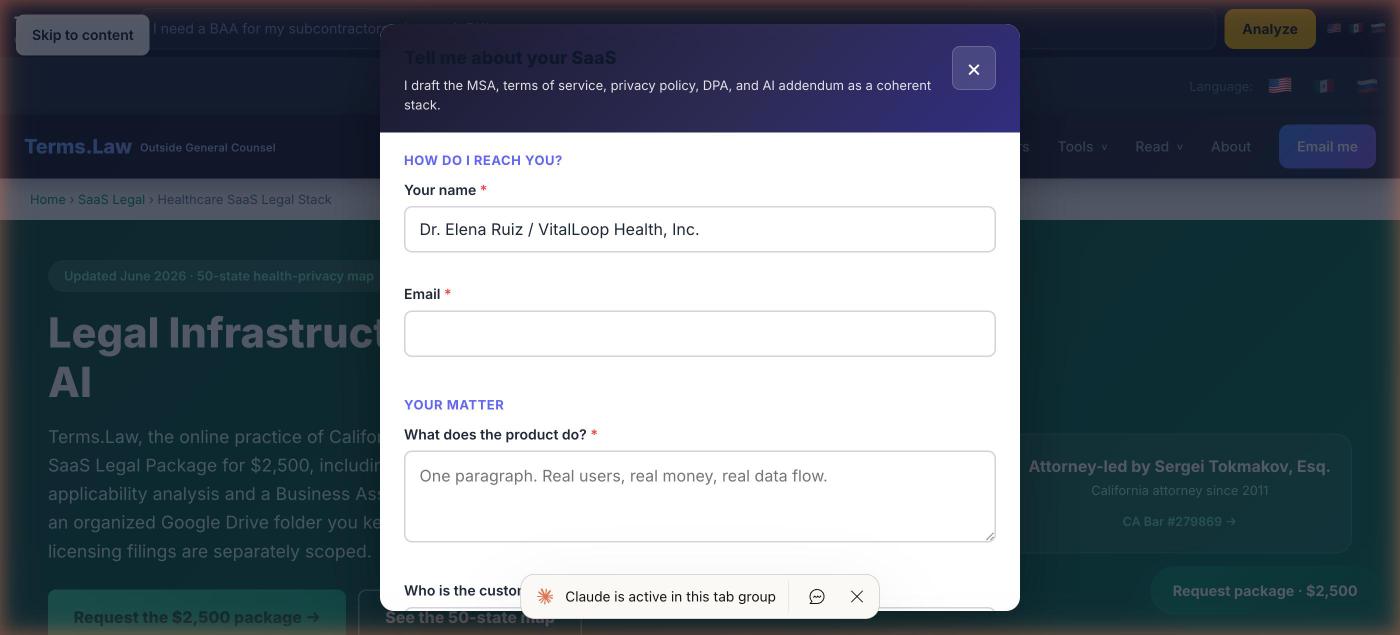
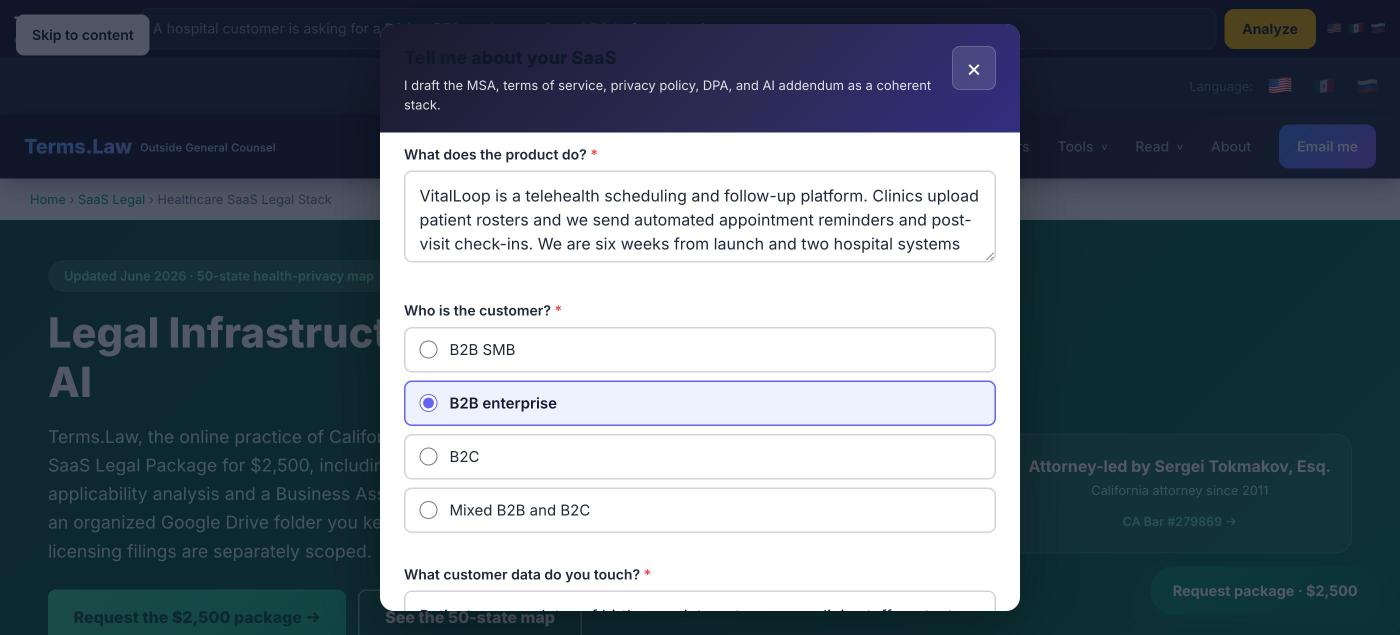
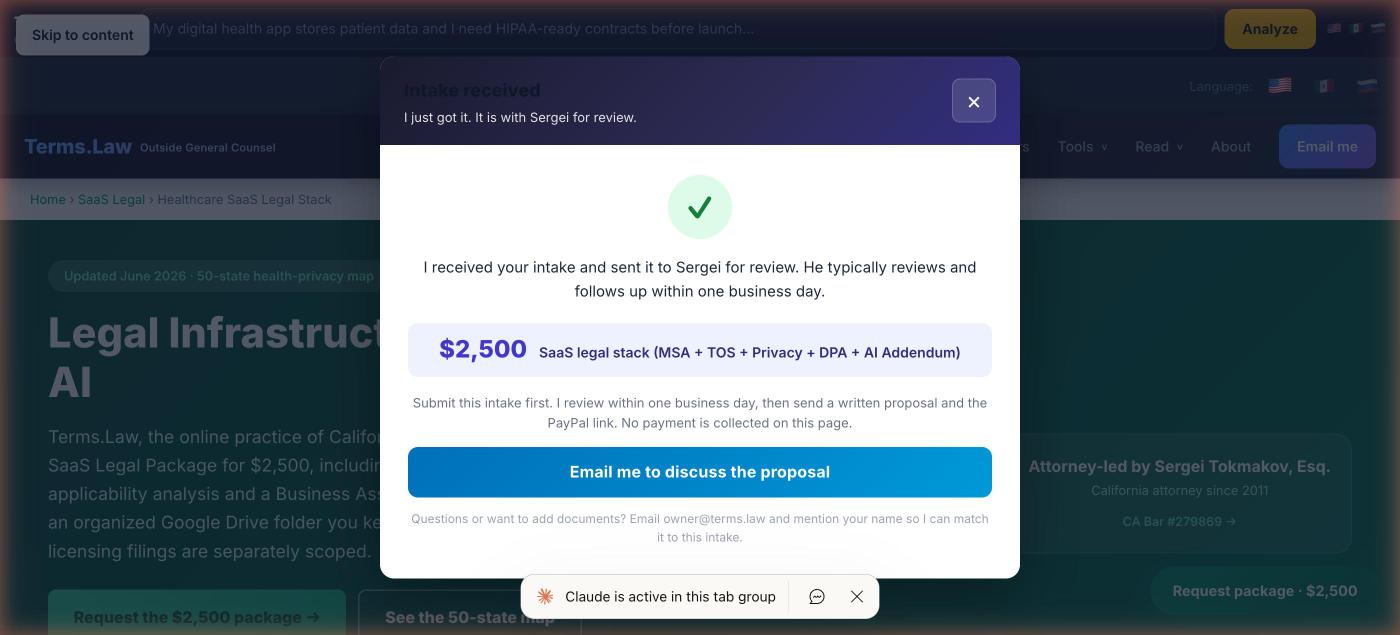
Screens captured from the live site. Prospect details shown are a test submission, not a real client.
What the same flow looks like on a phone
Roughly half of legal intake arrives on mobile, and mobile is where most firm intake quietly breaks. Both the conversational entry point and the structured form collapse to one column with full-width tap targets, and nothing scrolls sideways.
What this actually produced, in numbers
Measured from live production on my own site, not projected:
- 197 leads captured through the chat and intake path.
- $8.4 million in total matter value disclosed by visitors describing their situations.
- 4.3 exchanges, 1.9 minutes per session on average. That is the qualifying conversation a fifteen-minute intake call would otherwise consume.
- 4 visitors were told they did not need to hire anyone. A screening layer is worth more than a lead vacuum, because unqualified leads cost attorney time, which is the only inventory a practice has.
The uncomfortable part, stated because a vendor who claims no limitations is not worth hiring: the email-capture rate is 14 percent, and building this surfaced several failure modes that only appeared under live traffic. Anyone who tells you it is a weekend project has not run one in production.
I build AI client workrooms for firms like yours
Big-Law-style client portals, built for solo and small firms by a licensed attorney you can actually see. The client uploads, AI organizes the matter, and a named lawyer reviews the legal work.
Try a live AI governance workroom
If I am implementing AI in your firm, the governance boundaries in this demo are exactly what I put in writing. Flip a tool's account type or training posture in the AI vendor matrix and watch its rating react in real time, work the confidentiality and citation-verification checklists, sort the risk register, and click any clause of the locked AI Use Policy to comment or suggest an edit in track changes.
Open the live demo workroom How I build these for firmsRelated resources on Terms.LawI've published a lot on AI in legal practice. These pages explain how I think - read them before you hire me.
Frequently asked questions
The questions every firm asks me before signing on. Short answers, written by me, in plain English.
Does using AI in legal practice violate CA RPC 1.1?
No, not by itself. California Rule 1.1 (competence) requires that I understand the technology I use, including its benefits and risks. The State Bar's Practical Guidance on Generative AI (published November 2023, revised May 14, 2026) is clear: I can use AI, but I must supervise outputs, verify citations, and not rely on AI for legal judgment. Refusing to use AI when it would benefit a client may itself raise competence concerns.
What about confidentiality under CRPC 1.6?
Rule 1.6 prohibits revealing client information without informed consent. Consumer or personal AI accounts may allow conversations to be used for model improvement unless the right data controls are turned off, which makes them the wrong place for client-confidential material. Business and API products are different: they typically come with contractual non-training commitments. The issue is never the brand name alone; it is the specific account type, settings, and contract terms. I use enterprise plans that contractually disable training, route through APIs that don't retain prompts, or redact identifying facts before pasting. A written AI Use Policy locks this in across the firm.
Do I need a written AI Use Policy?
If you have any staff, yes. CRPC 5.3 makes you responsible for supervising non-lawyer assistants, which includes AI tools. A written policy documents your supervision system: which tools are approved, what data is allowed, who reviews outputs, and how you handle client disclosure. Without it, a future bar complaint has no record of your guardrails.
Which AI tools are safest for legal work?
Claude (Anthropic) enterprise plans and ChatGPT Team/Enterprise both contractually disable training on your inputs. Microsoft Copilot for M365 inherits your tenant's compliance posture. Tools I avoid for confidential work: free-tier ChatGPT, Google Gemini free tier, and any vendor whose TOS lets them use your prompts for model training. The right tool depends on your data classification, not on which model is "smartest."
What if my AI tool's TOS doesn't allow legal-confidential data?
Then you can't put privileged material into it. Period. Many free or consumer tiers reserve broad rights to use inputs for training and improvement. The fix is either to upgrade to a contractually compliant tier, switch vendors, or restrict that tool to redacted hypotheticals and public material. Vendor diligence is the first thing I check in every audit.
How do I disclose AI use to clients?
There's no universal duty to disclose, but Rule 1.4 (communication) and the State Bar guidance both point toward disclosure when AI materially affects the work product or fees. I draft engagement-letter addenda that explain in plain English what tools I use, how outputs are reviewed, and what data is and isn't sent to a vendor. Most clients appreciate the transparency.
Is AI-assisted work billable?
Yes, but only for the human time spent. Rule 1.5 prohibits unreasonable fees. If AI cuts a four-hour task to forty minutes, I bill forty minutes - not four hours. The efficiency gain belongs to the client. Where I do bill is for prompt engineering, output review, and the judgment work AI can't do.
What's ABA Formal Opinion 512?
ABA Formal Opinion 512 (July 2024) is the bar's first comprehensive guidance on generative AI. It addresses competence (Rule 1.1), confidentiality (Rule 1.6), supervision (Rules 5.1, 5.3), communication (Rule 1.4), fees (Rule 1.5), and candor to tribunals (Rule 3.3). California's State Bar adopted similar Practical Guidance in November 2023 and approved updated revisions on May 14, 2026, including treatment of newer agentic AI tools. Both are foundation reading for any firm rolling out AI.
Can I use AI for client intake?
Yes, with two cautions. First, an AI intake bot can't form an attorney-client relationship or give legal advice - it has to be branded as informational, not "AI lawyer." Second, prospective-client information triggers Rule 1.18 duties around confidentiality and conflicts. I build intake chatbots that route to attorney review, capture only what's needed, and don't pretend to be a lawyer.
What if AI hallucinates a citation?
It happens, and Rule 3.3 (candor to the tribunal) makes you responsible for what you file. The fix is verification: every cite gets checked against the primary source before it leaves the firm. My AI Use Policy templates make this an explicit checklist step. Several sanctioned attorneys in 2023-2024 learned this rule the hard way.
Legal-Tech / Workroom Strategy Session ($1,000)
For founders, lawyers, consultants, and SaaS or AI builders who want to work through AI-assisted legal workflows, workroom structure and architecture, legal intake design, or implementation strategy. I am happy to discuss this in a paid engagement. I do not do unpaid architecture calls, product-feedback calls, or quick chats about how to build competing systems. It is priced above a standard legal consult because implementation and architecture talk can leak the moat.
No unpaid architecture or product-feedback calls.
Start with the $2,500 audit
Flat fee. Written deliverables in 14 business days. If after the audit you want a custom implementation, I credit the audit fee against the implementation quote.