The intake form that failed silently for five weeks - Terms.Law itselfMy own structured intake form, loaded on roughly 3,800 pages, posted to a server route that was never implemented.
The problem
My own structured intake form, loaded on roughly 3,800 pages, posted to a server route that was never implemented. Every submission failed while the visitor saw a false success message. Roughly two to three completed intakes per week were silently lost for about five weeks, sized precisely from GA4 event history.
What happened next
A code-verified audit run with an AI coding agent under my direction found it. A working server-side handler plus honest failure copy shipped the same day, a genuine inquiry arrived through the repaired pipeline within minutes of the deploy, and a monitoring canary now watches the route so this class of failure cannot sit undetected again. Read the full case study.
Booking pipeline hardening - payment-first scheduling for $400 sessionsI built a payment-first booking pipeline for my $300 Written Attorney Consultations: a tentative hold on the slot, then PayPal webhook auto-confirmation that...
The problem
I built a payment-first booking pipeline for my $300 Written Attorney Consultations: a tentative hold on the slot, then PayPal webhook auto-confirmation that mints the Zoom meeting, the calendar event, and the confirmation email only after money is verified. In the first live week, a duplicate hold caused an automated release email that a paying client read as a payment failure.
What happened next
The same day, the system went through four rounds of adversarial AI code review: Claude built, a separate GPT auditor attacked, and I judged every finding. The audits produced strict amount and currency gates, idempotent confirmation that survives webhook replays, payment matching that refuses to guess between candidates, and client notifications that only claim success when it is true. Read the full case study.
Tiny traffic, $2,500 packages - the healthcare SaaS funnelA compact cluster of healthcare SaaS legal pages with tiny, high-intent traffic converts to the $2,500 flat-fee Healthcare SaaS Legal Package: MSA...
The model
A compact cluster of healthcare SaaS legal pages with tiny, high-intent traffic converts to the $2,500 flat-fee Healthcare SaaS Legal Package: MSA and order form, HIPAA BAA, terms of service, privacy policy, DPA framework, and a compliance gap memo. Every engagement is delivered in a custom, interactive client workroom generated per client, not a stack of Word attachments.
The result
Package purchases increased materially once the hub, the package framing, and workroom delivery were all in place, and the buyers are exactly who the pages were written for: health-tech founders at pre-launch. The funnel shape, authority pages plus AI triage plus a scoped package plus workroom delivery, is now the template for other verticals. Read the full case study.
The intake system, screen by screen
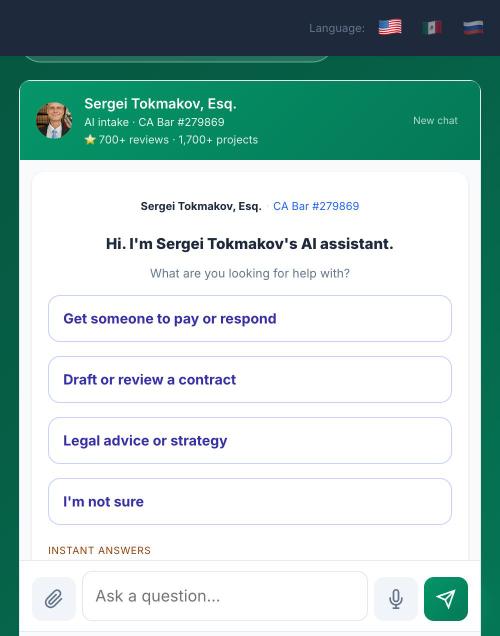
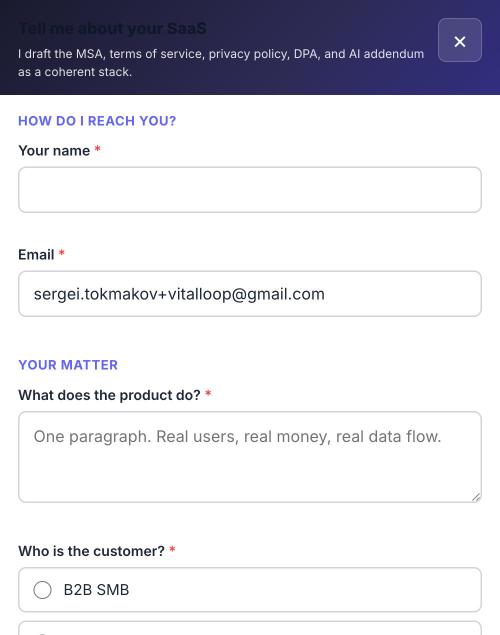
Here is that funnel as a prospect sees it. These are live screens from the Healthcare SaaS legal package page described just above. Across 278 sessions the system averages 4.3 exchanges and 1.9 minutes before it either routes someone to a fixed-fee package or tells them they do not need to hire anyone.
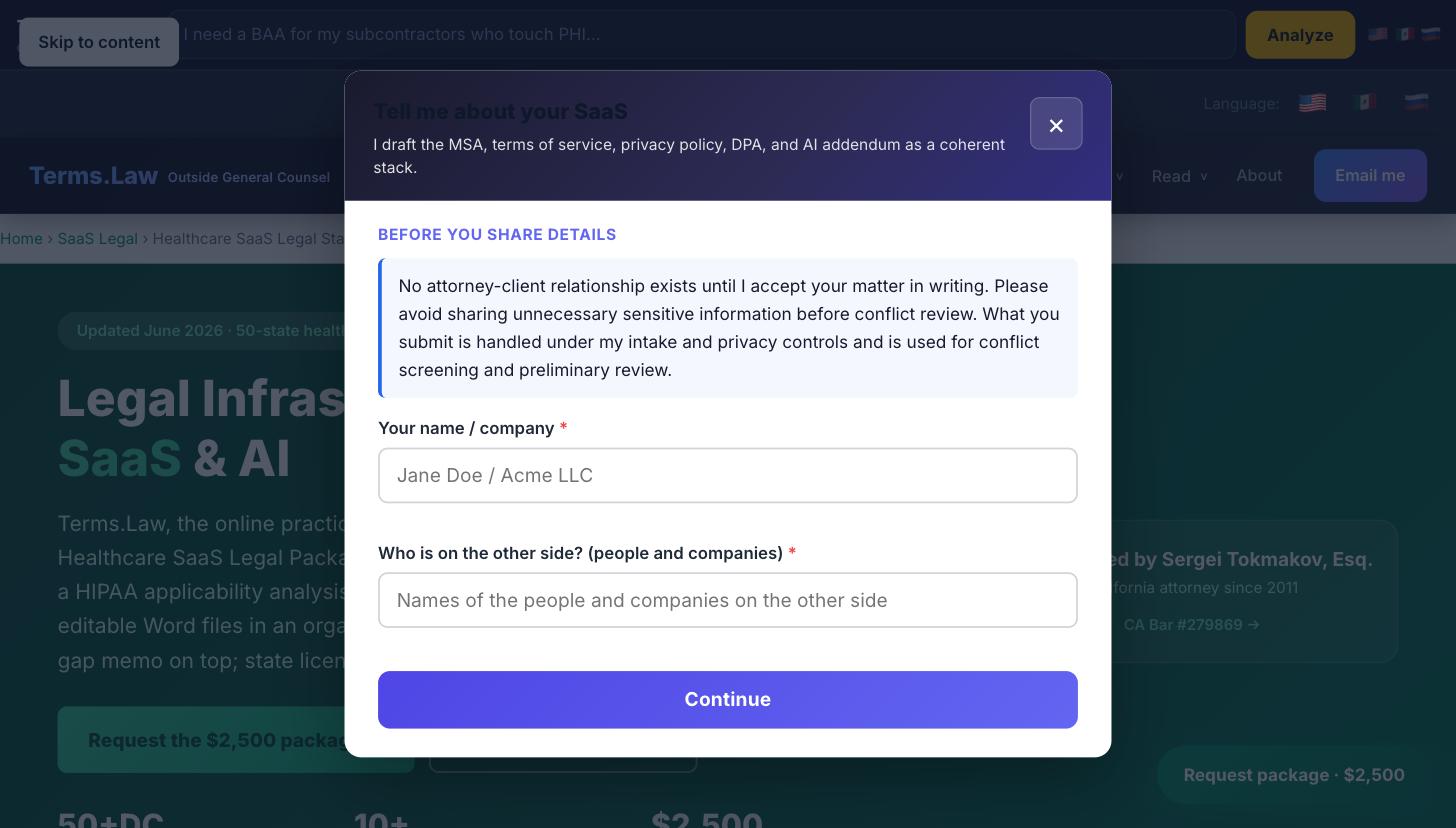
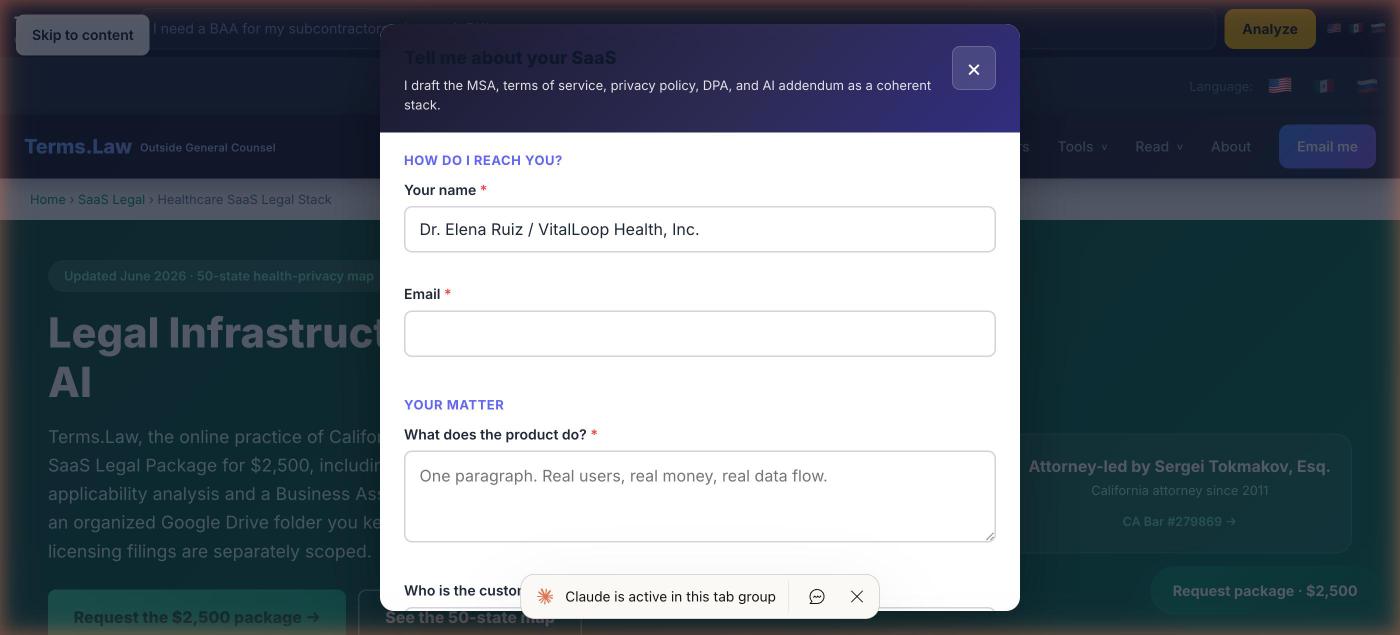
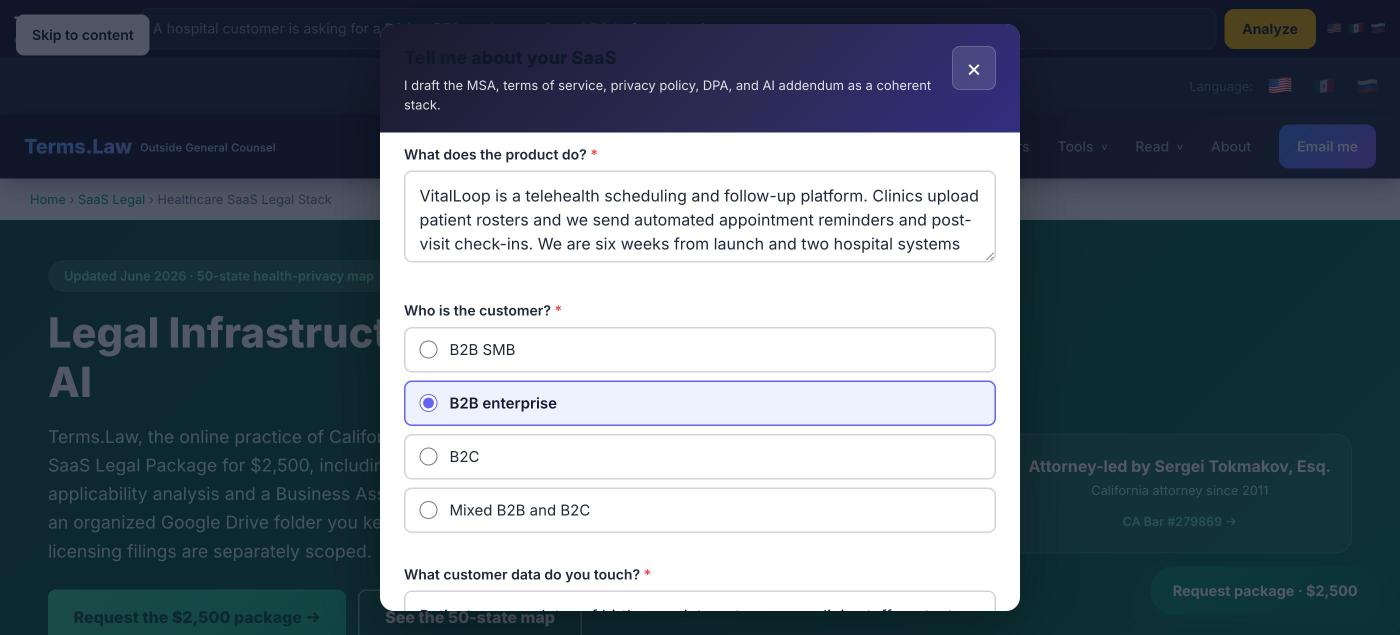
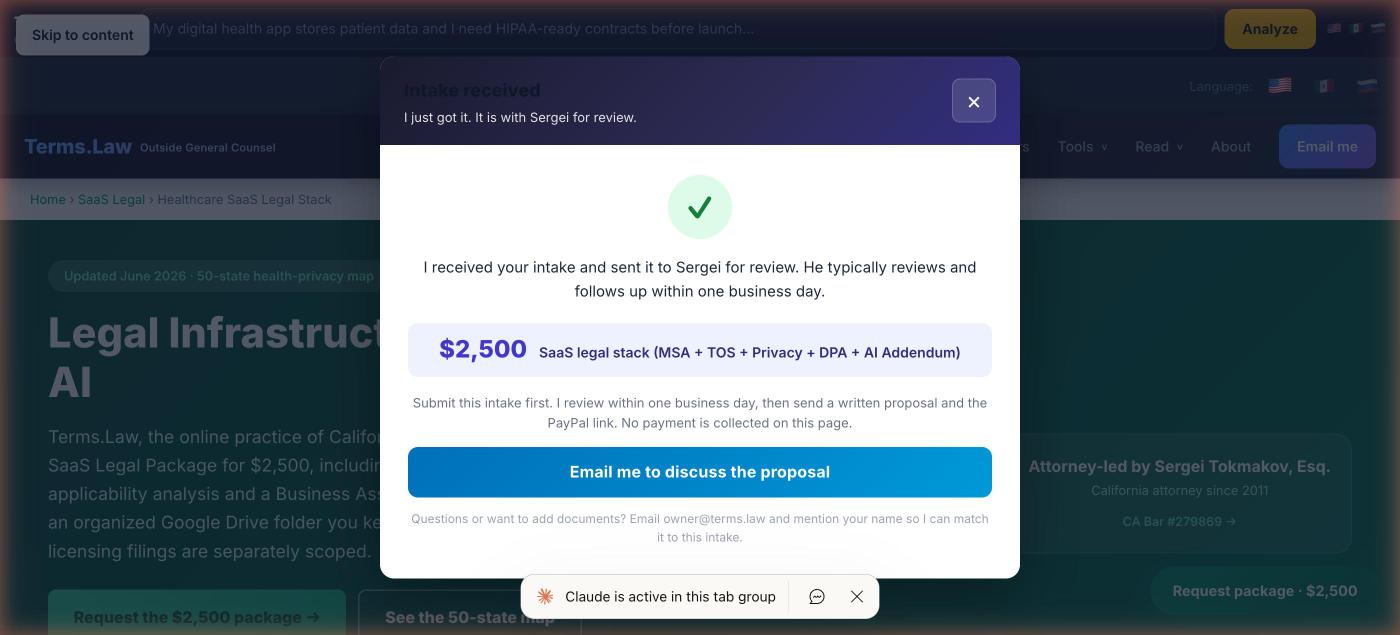
Screens captured from the live site. Prospect details shown are a test submission, not a real client.
What the same flow looks like on a phone
Roughly half of legal intake arrives on mobile, and mobile is where most firm intake quietly breaks. Both the conversational entry point and the structured form collapse to one column with full-width tap targets, and nothing scrolls sideways.
What this actually produced, in numbers
Measured from live production on my own site, not projected:
- 197 leads captured through the chat and intake path.
- $8.4 million in total matter value disclosed by visitors describing their situations.
- 4.3 exchanges, 1.9 minutes per session on average. That is the qualifying conversation a fifteen-minute intake call would otherwise consume.
- 4 visitors were told they did not need to hire anyone. A screening layer is worth more than a lead vacuum, because unqualified leads cost attorney time, which is the only inventory a practice has.
The uncomfortable part, stated because a vendor who claims no limitations is not worth hiring: the email-capture rate is 14 percent, and building this surfaced several failure modes that only appeared under live traffic. Anyone who tells you it is a weekend project has not run one in production.
Proposals as interactive case dashboardsText cover letters on Upwork all read alike, and a prospect cannot verify prose.
The problem
Text cover letters on Upwork all read alike, and a prospect cannot verify prose. I replaced them with private, interactive case dashboards built per job: a plain-statement read of the prospect's situation, a risk map of the issues, flip cards with the detail behind each one, a fee table with inclusions and exclusions, and an engagement timeline.
How it works
Claude Code assembles each dashboard from public posting facts in minutes; the remaining attorney hour is line-by-line review, citation verification, and a verb scan of every commitment. No confidential material before engagement, no legal conclusions dressed as findings. The conversations now start in the middle instead of at the beginning. Read the full case study.
Solo plaintiff-side employment firm - CaliforniaSolo attorney with one paralegal and roughly forty open matters.
The problem
Solo attorney with one paralegal and roughly forty open matters. She'd been pasting deposition transcripts into the free tier of ChatGPT to summarize them, and realized that consumer AI tools can create confidentiality and training-use issues unless the firm understands and configures the product's data controls. She wanted to keep using AI but stop bleeding privileged material into a vendor's system.
What I delivered
- 12-page written AI Use Policy keyed to California RPCs 1.1, 1.6, 1.4, 1.5, and 5.3
- Vendor matrix scoring six AI tools (ChatGPT, Claude, Gemini, Copilot, Perplexity, Lex.page) on training, retention, BAA availability, and price
- One-page client AI-disclosure addendum for engagement letters
- Workflow change: pasted transcripts now go through a redaction pass first, then to a Claude Team account
- One-hour live training session for the attorney and paralegal (recorded)
Outcome
Free-tier ChatGPT use stopped the day the policy went live. The firm switched to a Claude Team workspace with contractual non-training and saw deposition-summary time drop from roughly 90 minutes to 25, with zero confidential material entering a non-compliant vendor. She refers other plaintiff solos to me now.
In-house legal team - Series B SaaS, ~120 employeesOne GC, two contracts managers, and procurement was pushing back on every vendor that wanted to use AI for support tickets.
The problem
One GC, two contracts managers, and procurement was pushing back on every vendor that wanted to use AI for support tickets. The GC wanted a written internal AI Use Policy plus a tool that would let her team red-flag inbound NDAs without paying outside counsel for every two-page document.
What I delivered
- Internal AI Use Policy (8 pages) addressing the unique posture of an in-house team (vendor-sourced AI vs. firm-sourced)
- NDA Red-Flag Reviewer: a Claude-powered tool that scores inbound NDAs against a 14-point internal checklist and outputs a one-paragraph recommendation
- Vendor diligence template the contracts managers could use without me
- Board-level one-page summary the GC could show the CEO and audit committee
- 30-day post-deployment support (Slack channel, two weekly office hours)
Outcome
The red-flagger handles roughly 80% of inbound NDAs without escalation. The GC reports she's saving about six hours a week. Procurement now has a vendor questionnaire that they can apply to any new AI tool without re-engaging me each time.
Mid-size accounting firm - Texas20-person firm.
The problem
20-person firm. The managing partner had built a Google Docs template library for client engagement letters, but every new engagement still took 20-30 minutes to assemble. They wanted a generator their staff could use without me holding their hand each time, and they wanted the AI workflow documented before their malpractice carrier asked.
What I delivered
- Web-based engagement-letter generator (hosted on their domain): seven form fields, conditional logic for service line, Word/PDF output
- AI-assisted scope-section drafter that turns three bullet points into a polished paragraph
- Written AI Use Policy targeted at accounting practice (engagement letters, tax memos, client comms)
- Client AI-disclosure paragraph included in every generated engagement letter
- 30-minute training for the four people who'd use it
Outcome
Engagement-letter time dropped from 20 minutes to under 2. The firm rolled the same workflow to tax-memo drafting in month two on their own using my policy as the template. Malpractice carrier was satisfied with the documented review process.
Boutique business-litigation firm (six lawyers) - IllinoisThe managing partner wanted to formalize AI use across the firm before the Illinois Supreme Court announced its expected AI competence guidance.
The problem
The managing partner wanted to formalize AI use across the firm before the Illinois Supreme Court announced its expected AI competence guidance. Two associates were already using Claude for research; one partner refused to touch it. The partner wanted a single policy everyone could live with.
What I delivered
- 14-page AI Use Policy with three tiers: (a) approved for all matters, (b) approved with supervision, (c) prohibited
- Citation-verification checklist (the firm had been spooked by the Mata v. Avianca and Park v. Kim sanctions cases)
- Engagement-letter language for clients who explicitly ask about AI
- Vendor matrix focused on Claude, ChatGPT, and Lexis+ AI
- One-hour training for all six lawyers and the paralegal
Outcome
The skeptical partner signed off on the tier-based approach and now uses AI for non-substantive tasks. The firm reported zero AI-related incidents in the six months after policy adoption. They re-engaged for an Illinois rules update when ABA Opinion 512 came out.
Solo intellectual-property attorney - New YorkQuick question, not a full engagement: he was about to sign a new SaaS contract with an AI-powered docket-management tool.
The problem
Quick question, not a full engagement: he was about to sign a new SaaS contract with an AI-powered docket-management tool. The vendor's TOS had a broad input-use clause that worried him. He wanted a written attorney opinion plus suggested redlines, on the clock.
What I delivered
- 1.5-hour written analysis identifying three problem clauses (input-use, retention, indemnity)
- Redline-ready proposed language for each clause
- Short memo on which clauses the vendor was likely to accept vs. push back on
Outcome
Vendor accepted two of the three redlines without negotiation. The third went back to a middle position both sides could live with. He signed up for a $2,500 audit three months later when he hired his first associate.
Want yours on this list?
The $2,500 Audit & Policy Package is the most common starting point. Custom implementations follow when you want the AI to actually do the work, not just the supervision.