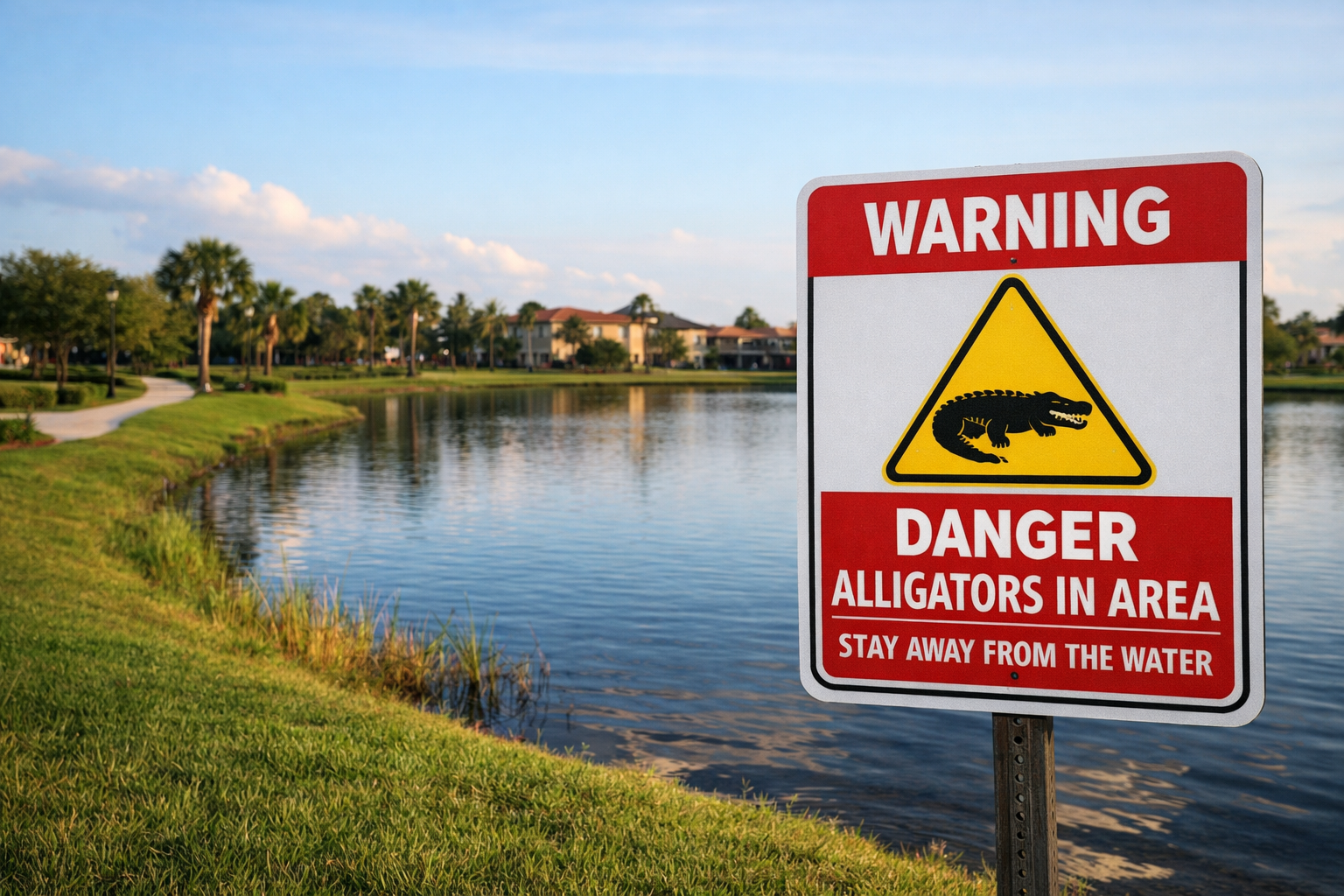
When an Alligator Attack Becomes Someone Else's Liability
Florida averages 10-15 serious (major or fatal) unprovoked alligator attacks per year. Unlike California's strict liability for dog bites, Florida has no automatic liability for wild alligator attacks. However, property owners can absolutely be held liable under premises liability when they knew or should have known about a dangerous alligator and failed to warn or take reasonable steps to address it.
The "Known Gator" Theory
The strongest alligator attack claims involve what attorneys call the "known gator" situation:
- Prior Sightings: Residents, guests, or staff had reported seeing an alligator in the same area before the attack
- Complaints on Record: Emails, maintenance tickets, or HOA meeting minutes showing people complained about the gator
- Prior Incidents: Near-misses, aggressive behavior, or previous attacks at the same location
- Staff Knowledge: Property managers, maintenance workers, or security knew about the alligator
- The "Nickname Test": If residents had a nickname for the gator ("Larry" or "Old Pete"), that's powerful notice evidence
⚠️ Critical Deadlines
Is There Someone to Sue?
Not every alligator attack has a viable defendant. Use this quick assessment:
- HOA retention pond with prior sightings
- Resort lagoon near guest amenities
- Apartment complex with known gator
- Golf course water hazard, no warnings
- Property with feeding/attractant issues
- Wild encounter in natural habitat
- Trespassing on private property
- Swimming despite clear warnings
- No prior notice or sightings
- Victim was feeding/provoking
Florida Premises Liability Framework
Alligator attack claims are typically brought under premises liability negligence. Unlike dog bite cases with strict liability statutes, you must prove traditional negligence elements:
| Element | What You Must Show |
|---|---|
| Duty | Defendant controlled the premises and owed a duty of care based on your status (invitee, licensee, tenant) |
| Breach | Failed to warn of known danger, failed to remove/report nuisance alligator, created attractant conditions |
| Foreseeability | Prior sightings, complaints, incidents, or habituation made attack foreseeable |
| Causation | The failure to warn/act was a substantial factor in causing your injuries |
| Damages | Medical bills, lost wages, pain and suffering, scarring, PTSD |
The "Indigenous Wildlife" Defense (And How to Beat It)
Property owners often cite Palumbo v. State Game & Fresh Water Fish Commission (487 So.2d 352) for the proposition that alligators are "indigenous to Florida" and attacks are unforeseeable. Here's how plaintiffs win anyway:
- Actual Knowledge: "This wasn't about indigenous wildlife generally—you knew THIS gator was here"
- Prior Incidents: "After the first near-miss, you can't claim surprise"
- Human Conduct: "Feeding, attractants, and habituation created the danger"
- Invitation Cues: "Your design invited people to the water's edge without warnings"
- FWC Program: "You had a state removal program available and didn't use it"
FWC Nuisance Alligator Program (SNAP)
Florida's Fish and Wildlife Conservation Commission runs the Statewide Nuisance Alligator Program (SNAP). This is your "reasonable care" benchmark:
Feeding/Enticement: The Game-Changer
Florida law prohibits feeding or enticing alligators (FWC Rule 68A-25.001). If you can show feeding or attractant behavior, liability becomes much clearer:
- Staff Feeding: Employees or maintenance workers feeding the gator (even "just once")
- Resident Feeding: Known feeding by residents that property failed to stop
- Trash/Attractants: Poor waste management creating food sources near water
- Fish Cleaning Stations: Waste disposal that attracts alligators
- Habituation Evidence: Gator approaching humans without fear (classic sign of feeding)
Florida's Comparative Fault Rule
Florida's 2023 tort reform created a modified comparative fault system:
| Your Fault % | Recovery |
|---|---|
| 0-50% | Recover damages reduced by your % fault |
| 51%+ | BARRED - No recovery |
- "Victim knew Florida has alligators"
- "Victim was too close to the water"
- "Victim ignored general wildlife warnings"
- "Victim was in the area after dark"
Counter: General awareness of Florida wildlife is not the same as notice of a specific dangerous alligator at that location. The duty to warn exists precisely because visitors can't identify a particular dangerous gator in real time.
Potential Defendants in Alligator Attack Cases
HOA / Property Association Claims
HOA retention ponds are among the most common alligator attack locations. Key liability factors:
- Common Area Control: HOA maintains the pond, paths, and surrounding areas
- Board Knowledge: Meeting minutes, emails, or resident complaints showing notice
- Warning Adequacy: Generic "wildlife" signs vs. specific alligator warnings
- Vendor Responsibility: HOA can't escape duty by delegating to landscapers or managers
Resort / Hotel Claims
Resorts have heightened duties because guests are unfamiliar with local hazards:
- Guest Safety Duty: Non-locals rely on property to identify site-specific hazards
- Amenity Design: Lagoons, docks, and waterfront areas that invite guest use
- Child Safety: Family resorts must account for children near water
- Prior Incident Records: Guest complaints, near-misses, maintenance reports
Government Entity Claims (Parks, etc.)
Claims against state parks, county facilities, or municipal properties have additional procedural requirements:
Before suing a Florida governmental entity, you must:
- Provide written notice to the agency AND the Florida Department of Financial Services
- Wait 180 days for investigation
- Comply with statutory damage caps (unless pursuing a claims bill)
Missing this step can bar your entire claim.
Liability theory for government properties:
- Public Access: Parks invite public use of water-adjacent recreational areas
- Warning Duty: Knowledge of dangerous wildlife in high-traffic zones triggers warning obligations
- Prior Reports: Ranger logs, incident reports, visitor complaints
Evidence Checklist: What to Gather Immediately
📸 Site Documentation
- Photos/video of the exact attack location, water edge, and surrounding area
- All warning signs (or lack thereof) - photograph from approach paths
- Lighting conditions, especially if attack was at dawn/dusk/night
- Barriers (or absence of barriers) between paths and water
- Vegetation/sightlines - could you see the water's edge clearly?
- Amenities that invite water access (docks, seating, fishing areas)
📋 Records to Request/Preserve
- Security camera footage (30+ days before and after incident)
- Incident reports and internal communications about the attack
- Prior wildlife sighting reports, resident complaints, maintenance tickets
- HOA board minutes mentioning alligators, ponds, or wildlife
- Communications with FWC or wildlife authorities
- Vendor contracts for pond maintenance, landscaping, signage
- Prior claims or lawsuits involving alligators at the property
👥 Witness Information
- Names/contact info of attack witnesses
- Residents who reported prior sightings
- Staff/security who responded to the incident
- Maintenance workers who knew about the alligator
🏥 Medical Documentation
- Emergency room records, ambulance/EMS reports
- Surgery records, wound care, infection treatment
- Photographs of injuries (immediate and healing progression)
- Physical therapy, rehabilitation records
- Mental health treatment for PTSD, anxiety, fear
- All bills and statements of charges
Preservation Notice (Send Immediately)
Send this notice to the property owner/manager within days of the incident to prevent evidence destruction:
Recoverable Damages
- Emergency room / ambulance
- Surgery and hospitalization
- Wound care and infection treatment
- Reconstructive surgery
- Physical therapy / rehabilitation
- Future medical care
- Wages lost during recovery
- Lost earning capacity
- Business income losses
- Benefits and retirement impacts
- Physical pain and discomfort
- Emotional distress and PTSD
- Fear and anxiety (especially near water)
- Loss of enjoyment of life
- Embarrassment from scarring
- Survivors' lost support
- Loss of companionship
- Funeral and burial expenses
- Estate's damages (pain before death)
Alligator Attack Injury Characteristics
Alligator attacks typically involve severe injuries that justify substantial damages:
| Injury Type | Common Issues |
|---|---|
| Bite Wounds | Deep punctures, crushing injuries, tissue avulsion, multiple surgeries |
| Infection Risk | Alligator mouths carry dangerous bacteria; often requires IV antibiotics, extended treatment |
| Amputation | Limb loss from "death roll" injuries; prosthetics, lifetime care |
| Scarring | Permanent disfigurement, skin grafts, psychological impact |
| PTSD | Fear of water, nightmares, anxiety, avoidance behaviors - often lifelong |